


The mental health emergency is disproportionately affecting people in homelessness
The Wallich has launched a new campaign exploring the issues of crisis mental health, homelessness and co-occurring substance use in Wales.
Why do we need this campaign?
During the early pandemic, between March and October 2020, our specially trained support staff helped more than 4,000 people experiencing homelessness.
In uncertain times, one thing was certain. We needed to continue to respond to anyone who needed us.
24 of our services across Wales were classed as ‘critical services’ and our frontline staff worked tirelessly, offering accommodation, wellbeing, financial and health support throughout lockdowns.
At the same time, data analysis by Mind revealed that more people experienced a mental health crisis during the coronavirus pandemic than ever previously recorded.
Staff survey on crisis mental health support
Our staff were increasingly concerned and frustrated by their inability to get help and support for people in mental health crisis.
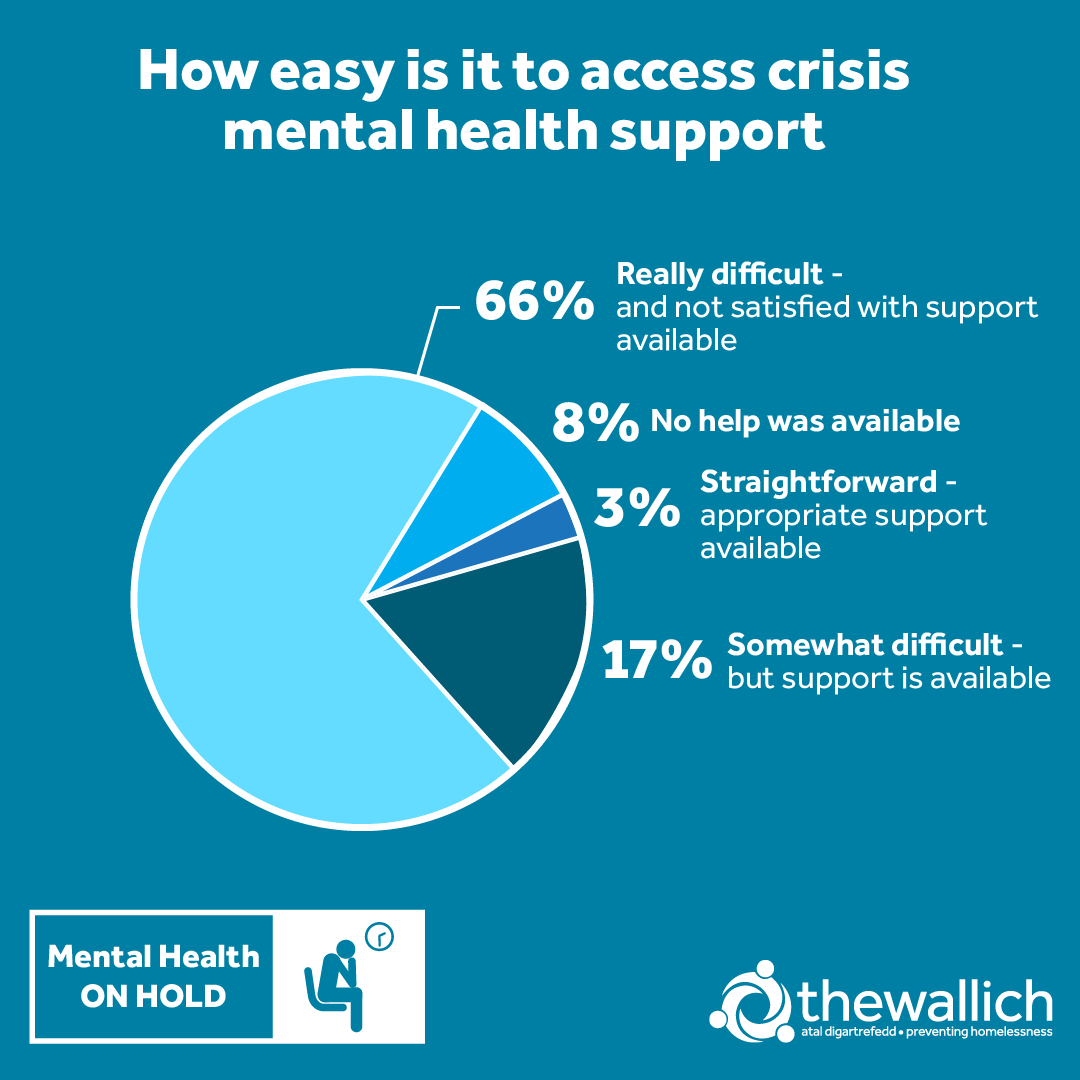
In a staff survey, completed by The Wallich in 2022:
96% of staff surveyed had supported clients in mental health crisis.
95% had sought support from Community Mental Health Teams (CMHT) or Crisis teams.
66% of staff surveyed found it extremely difficult to access this support and were not satisfied with the support available.
8% stated that no support was available.
And regarding the difficulty in accessing support during and after the pandemic:
72% feel that people experiencing homelessness have worse access to mental health services, compared with the general population.
60% of staff surveyed feel it is more difficult to access mental health support for clients since the outset of the pandemic.
Mental Health on Hold investigative report

We decided to investigate this further and sent Freedom of Information (FOI) requests to all health boards, local authorities, police forces and ambulance services in Wales, as well as to Welsh Government.
This wider campaign, which we have titled ‘Mental Health on Hold’ will provide evidence that;
The mental health emergency is disproportionately affecting people in homelessness
We have now released our Mental Health on Hold report. It includes:
- Responses from 35 FOI requests
- A survey of our staff
- Case studies
- Evidence from our service user database
The report details barriers to access and a breakdown in the mental health referral system, leading to vulnerable people in crisis being criminalised and retraumatised.
Topline Findings
- A frontline staff survey about accessing mental health support for people in crisis:
83% found it difficult to access the right support for clients (63% really difficult)
8% said that no help was available
Just 3% of staff said appropriate support was available
- Analysis of 4,216 records across 3 years, on our incident management system found:481 incidents of self-harm or suicidal ideation
294 incidents relating to drug or alcohol overdoses
1,508 incidents of erratic or aggressive behaviour
- 35 FOI requests to public services show:Whilst on paper services claim to be accessible to all who need them, in practice there are real barriers faced by people experiencing homelessness, despite high levels of need.
The report also outlines solutions to the current crisis – both from ourselves in response to the issue, and recommendations to others funding, commissioning and delivering services across Wales.
It is careful not to assign blame to any service – acknowledging services are all stretched to their limits, and that there is much good work happening across Wales.
We conclude by outlining that steps needed to tackle the issue are not revolutionary.
Our recommendations focus on ways to re-incentivise partnership working, to develop holistic, person-centred services. We cite the Trauma Informed Wales Framework as a great example of how this could work in practice, by putting questions of accessibility right at the heart of service design.
CW: The report contains explicit references and descriptions of suicide, self-harm, drug and alcohol use and violence.
Get involved with our campaign
Check back on this page for updates and related articles about the campaign or sign up to our newsletter.